Most companies don’t think about calibration until something goes wrong.
A machine starts producing inconsistent results. A client questions a report. An audit is approaching, and suddenly someone realizes that a calibration certificate expired months ago.
By then, the issue is no longer just calibration. It becomes a problem of downtime, delays, compliance concerns, and unexpected costs.
Many industrial companies invest heavily in equipment, maintenance, and operations. However, measuring instruments often don’t receive the same level of attention.
The surprising reality is that these small devices can have a significant impact on an entire operation.
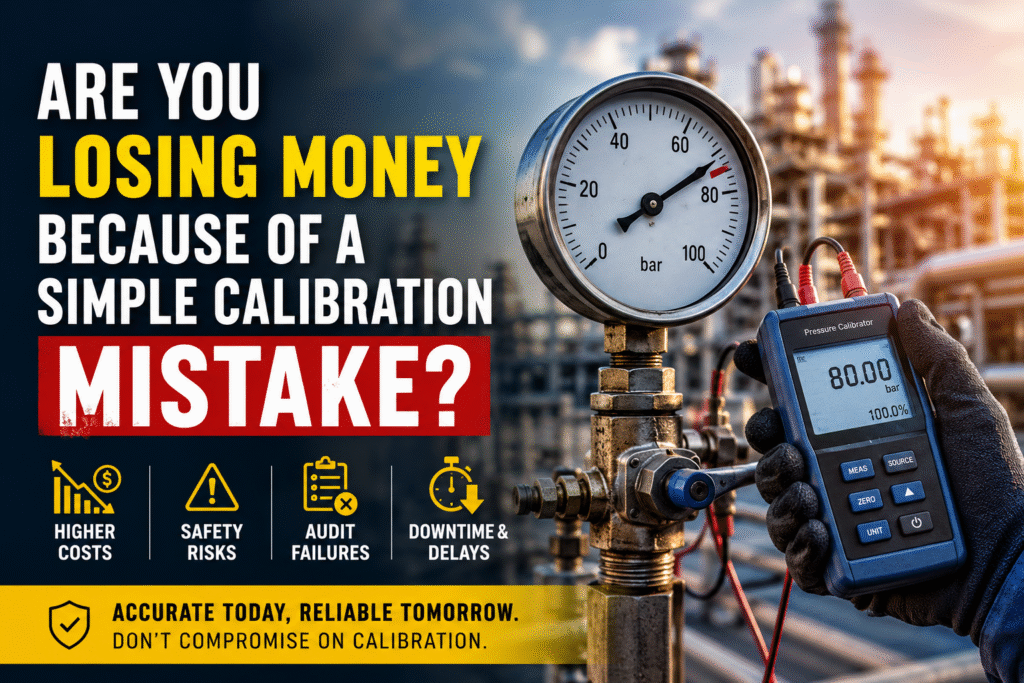
Take a pressure gauge as an example. If it provides inaccurate readings, operators may make decisions based on incorrect information. The same applies to temperature sensors, flow meters, and gas detectors.
Everything may appear to be working normally, but the data being used is no longer reliable.
Calibration is often viewed as a technical requirement or simply a task that needs to be completed before an audit.
In reality, it is much more than that.
Calibration provides confidence that:
Equipment is performing accurately
Measurements can be trusted
Operations remain safe and efficient
Quality standards are maintained
Accurate measurements help businesses make informed decisions and avoid costly mistakes.
One of the most common mistakes is waiting until audit season to review calibration records.
Another is assuming that an instrument is accurate simply because it appears to be functioning normally.
The challenge is that measurement errors often develop gradually. There are usually no obvious warning signs until the problem starts affecting operations.
By that stage, companies may already be dealing with production issues, failed inspections, customer complaints, or unnecessary downtime.
The good news is that most calibration-related problems can be prevented.
A few simple practices can make a significant difference:
Maintain a regular calibration schedule
Keep calibration certificates organised and up to date
Track expiry dates before they become a problem
Ensure critical instruments receive priority attention
Work with qualified calibration professionals
These small steps can help prevent much larger issues in the future.
As industries continue to adopt automation, digital monitoring, and advanced operational systems, the importance of accurate measurements continues to grow.
Companies are increasingly focusing on reliability, compliance, and operational efficiency. Calibration plays an important role in all three areas.
Modern facilities are also moving towards digital record management, predictive maintenance, and smarter monitoring systems to improve operational performance and reduce unexpected downtime.
Calibration is one of those things that rarely gets attention when everything is working properly.
However, when it is overlooked, the consequences can be significant.
A small measurement error can lead to delays, compliance issues, production losses, equipment damage, or unexpected shutdowns.
The cost of regular calibration is often far lower than the cost of dealing with these problems later.
At the end of the day, calibration is not just about certificates or audits. It is about ensuring that your equipment, your data, and your decisions can be trusted.
Rishmal is a Digital Marketing Executive specializing in SEO and content marketing for industrial service companies. He works closely with businesses in the inspection, calibration, and asset integrity sectors, helping them improve their online visibility and reach the right audience. Learn more about industrial inspection and calibration solutions at AIM KSA.
AIM Inspection And Calibration,
Dammam, Eastern, Saudi Arabia
Fill out the form below to get a personalized quote tailored to your needs. Our experts will get back to you promptly!